In recognition of the
importance of Juneteenth, Athraigh Print Studio presents a small exhibit of
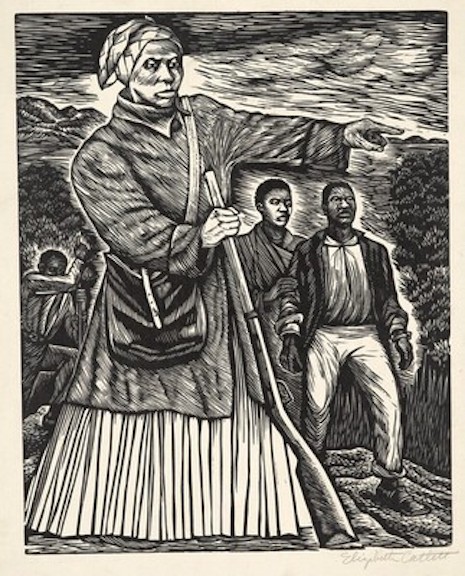
prints created by African American printmakers in honor of Harriet Tubman:
Harriet Tubman, American,
1822 - 1913
albumen and silver on
photographic paper on card mount
Collection of the National
Museum of African American History and Culture shared with the Library of
Congress
In
August of 1963, The March on Washington was held to advocate for the civil rights
of African Americans. Martin Luther King Jr delivered his "I Have a
Dream" speech, calling for an end to racism.
The art
collective, The Spiral Group formed as a result of the march.
“…Spiral
was a New York–based collective of African-American artists that came together
in the 1960s to discuss their relationship to the civil rights movement and the
shifting landscape of American art, culture and politics…”
An
artist in the group who I particularly admire is Emma Amos.
Emma
Amos (1937 – 2020) was invited in 1963, by her professor,“…Hale Woodruff to become a member of Spiral,
a group of black artists that included Romare Bearden, Norman Lewis, and
Charles Alston. She was the group’s youngest and only female member…”
Prints
and paintings by Emma Amos are in the collections of the Museum of Modern Art,
the Studio Museum of Harlem, the Whitney Museum of American Art, and the
Brooklyn Museum. Emma Amos died on May 21 at her home in Bedford, N.H. She was
83. In 2021, a retrospective of the artist’s work will open in her home state,
at the Georgia Museum of Art in Athens.
Stars and Stripes,
monotype with George Shivery photo
transfer, 1995
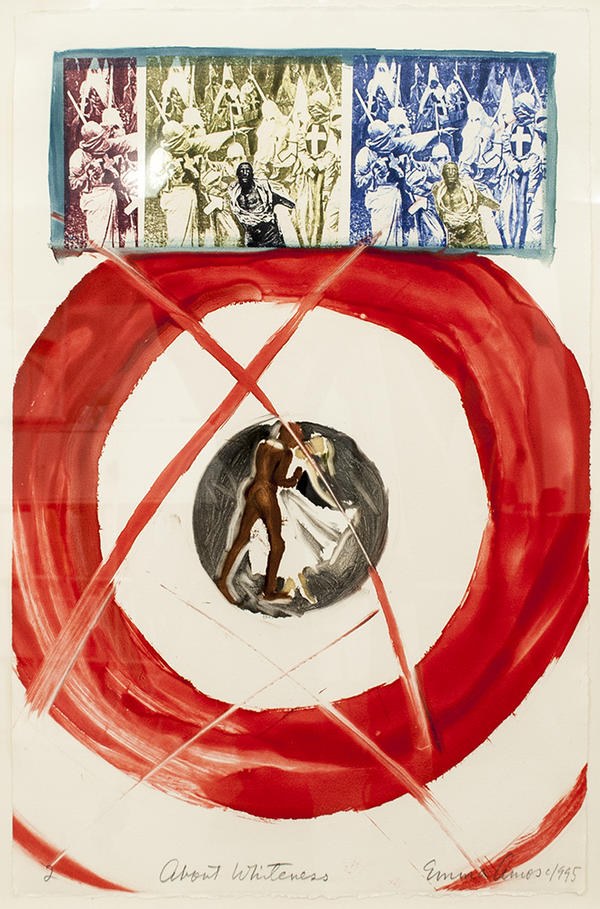
About
Whiteness (Red)
oil and
laser transfer on paper. 1995
Measuring,
Measuring
Acrylic
on linen canvas, Kente fragment, batiked hand swatches, African strip woven
borders, and laser-transfer photographs, 1995.
Mississippi Wagon, 1937,
print, 1992
My Mothers, My Sisters,
lithograph, handmade paper collage,
African fabric border, 1992
Contemporary
African American artists continue the work of Spiral:
Black
Art In America
SPIRAL
NOW 55 Years Later: New Artists, Familiar Struggle
Printmaking in the time of
COVID-19. Small Exhibitions:
Barbara Jones-Hogu
(1938
– 2017)
African American Protest Art of the
Sixties, Seventies
African
Commune of Bad Relevant Artists (AfriCOBRA).
In
1968, printmaker Barbara Jones-Hogu was a founding member of the Chicago group,
African Commune of Bad Relevant Artists (AfriCOBRA). The artists of AfriCOBRA made
visual, the central ideas of the Black Power movement—self-determination,
unity, and black pride.They
agreed to embrace a style that emphasized strong bold colors, flat shape,
rhythm, and text to highlight the heroic and beautiful qualities of black lives
in America.
The prints created by Barbara
Jones-Hogu, stand as brilliant works of art and at the same time reveal a glimpse
into America’s history of embedded racism and the importance of protest.
Land Where My Father Died
Color screenprint on gold-colored
Japanese-style laid paper. 1968
“…I feel that racism and fascism
played a great deal in my father being successful or not successful in his
life, so some of these prints’ ideas and content deal with the fact that we and
he were not really free to do whatever we and he really wanted to do and could
do due to radical oppression and suppression…”
“…In Nation Time, a dominant figure
leads a black ensemble to rise up against the American flag background. Closer
looking reveals that the American flag’s stars are Ku Klux Klan members. In
this way, the composition acknowledges how racism is deeply embedded in
America, while also inspiring hope of overcoming that truth…”
“…The guns and the lights on them
and various actions against and between the military and the protesters caused
me to think that we should be our brothers’ keeper…”
Over 103,000 people have now died from COVID - 19. Our government officials want you to only see numbers but we know each number is/was a person. Athraigh Studio continues its effort to look beyond the numbers and into the art made by the people.
In the U.S. people of color are at greater risk than others. Among the most vulnerable are Native Americans. Today, in the third exhibit detailing Who are the people COVID – 19 is Killing in Your Neighborhood ?, Athraigh Studio brings you examples of the art of the Sioux and a few related details regarding their battle to save the earth and their people from the greed of big oil companies.
Historically, the Sioux reside in reservations, communities, and reserves in North Dakota, South Dakota, Nebraska, Minnesota, and Montana; and Manitoba, southern Saskatchewan, and Alberta in Canada.
The Sioux include the Lakota - the westernmost people, the Nakota - the middle of the three Sioux nations, and the eastern - Dakota.
For this post let’s focus on a brief history of the Lakota people:
In the early 1860’s U.S. greed for gold resulted in the Bozeman Trail carving through Sioux lands in violation of the Fort Laramie Treaty of 1851.
The Bozeman War or Red Cloud’s war resulted and lasted until the late 1860’s. Red Cloud’s victories left the Sioux in control of the Western Powder River country and permanently closed the Bozeman trail resulting in the, The 1868 Treaty/Treaty of Fort Laramie,
which established the Great Sioux Reservation lands west of the Missouri River including the Black Hills.
Sitting Bull and his group of Hunkpapas did not sign the treaty and did not confine themselves to the reservation, thus they were characterized as "hostiles” by the U.S. Government.
The discovery of gold in the Black Hills in 1874 by an Army expedition led by Lt. Col. George Armstrong Custer, prompted the US Government to offer to purchase the Black Hills from the Sioux, who refused to sell their sacred land.
The army allowed miners to enter Sioux land and demanded all Sioux, including Sitting Bull, to report to the reservation. Sitting Bull’s refusal resulted in the Army efforts to forcibly bring him in, culminating in the Battle of the Little Bighorn in 1876.
Congress’s Act of February 28, 1877 (19 stat. 254), quickly stole back the Black Hills from the Great Sioux Reservation.
Further the Act of March 2, 1889 (Dawes Act and the Allotment Act) reduced the Great Sioux Reservation, into six separate reservations. The Act opened reservations throughout the U.S to development by non-Indian business, thus creating checker-boarded land ownership within Sioux (and other Native American) reservations.
Though the Sioux legally maintain jurisdiction on all reservation lands, on-going jurisdictional disputes in criminal and civil court result from the Act. The Sioux’s ongoing battles to stop encroaching greed and preserve their land is today centered in their opposition to major oil pipeline construction.
The 1,210 mile Keystone XL oil pipeline (similar to the operational pipe, also called Keystone) runs from Hardisty, Alberta, to Steele City, Nebraska and is designed to transport Canadian tar sands, the world’s dirtiest oil, creating major risks to climate and water.
in November 2015, President Obama vetoed the Keystone pipeline due to its’ threats to ecosystems, drinking water sources, and public health.
In January 2017, Trump reversed Obama’s veto, by signing an executive order to advance Keystone XL (as well as the Dakota Access Pipeline). Thankfully the pipeline had been on hold. TC Energy, formerly known as TransCanada, has had financing and permits issues and nonviolent civil protests have continued to slow the progress.
In March of 2020, thoughan epic glut of oil exists, oil prices have reached their lowest level in nearly two decades and though tar sands crude is some of the most expensive in the world to produce, the president and CEO of TC Energy announced a new effort to complete the pipeline, thanking his main supporters, Trump and Alberta Premier Jason Kenney who is dumping a billion Alberta dollars into the project.
Work started in April at the border crossing in northern Montana. In addition, site work for construction labor camps, some would house up to 1,000 temporary workers near Baker, Montana, and Philip, South Dakota has begun. The work in South Dakota has resulted in conflict between South Dakota Gov. Kristi Noem (R) and the Sioux.
The Cheyenne River Sioux Tribes and the Oglala Sioux Tribe have established checkpoints on federal and state highways running through reservation land in an attempt to keep COVID 19 infections away from their reservations.
Noem has turned to her allies in the Trump administration to force the Sioux to take down the checkpoints, allowing oil companies to access reservation land. Earlier, in March, Noem signed into law legislation that would include oil equipment as “critical infrastructure, ” along with fossil-fuel-backed anti-protest laws.
The Sioux and their supporters would risk not only criminal actions but exposure to COVID – 19 by engaging in the types of protests that have successfully slowed down pipeline construction on the past. This sets the stage for oil companies and their political supporters to profit while the Sioux and the world attempts to survive the pandemic.
The Sioux have diligently kept COVOID – 19 at bay since the first reports of COVID-19 in China. They have consulted the medical community and followed the path of science. In addition to the checkpoints they’ve stockpiled food supplies and established health policies including travel bans from the reservation as well as encouraging outsiders not to come to the reservations in order to prevent COVID-19 from reaching the people.
So, as the Sioux once again battle the U.S. government’s greed and desire for it’s current gold: OIL.
We can only hope they can continue to keep COVID – 19 from infesting their land as it has the Navajo. This will be impossible if the checkpoints are forced to be taken down and the oil companies fill their labor camps with temporary workers from across the country.
In celebration of the monumental efforts of the Sioux to preserve their existence (and our world), Athraigh Studio would like to help make you familiar with the art created by the people of the Sioux nation by presenting a small exhibition of current Lakota Sioux artists:
Joel Elgin,
Athraigh Studio. Printmaking in the time of COVID-19. Small Exhibitions: Who
are the people COVID – 19 is Killing in Your Neighborhood?
Apache and Pueblo Art/Printmaking.
Sung to the tune
of the Sesame Street song…
Who are the people
in Your Neighborhood? The people COVID – 19 is Killing Each Day. Apache and
Pueblo Art/Printmaking.
Over
89,000 people have died from COVID - 19. The Trump government wants you to see
only numbers but behind each number is a person.
In the U.S. people of color are at
greater risk than others. Among the most vulnerable are Native Americans.
Today,
in the second exhibit detailing Who are the people COVID – 19 is Killing in
Your Neighborhood? Athraigh Studio continues the intention of showing that
the dying are not just numbers, by bringing you examples of the contemporary
art/printmaking of the Apache and the Pueblo.
The
Apache and Pueblo are located in the in the Southwest Cultural Region
incorporating the lower parts of Utah and Colorado, all of Arizona and New
Mexico, and the northern deserts of Mexico. Like the Navajo, Hopi and the Zuni
they are battling COVID – 19 with little help from the Trump administration.
Let’s
examine how COVID – 19 is affecting Native Americans in New Mexico:
New
Mexico’s 23 tribes compose just 11% of the state population.
The
reported cases among tribal communities, combined, make up almost 60% of all
positive cases in New Mexico.
50%
of all people who had died of COVID-19 in New Mexico were Native American.
So,
who are the Apache?
Na
i sha Apache (Tribe of Oklahoma)
Chiricahua
Warm Springs Apache (Fort Sill Apache Tribe of Oklahoma)
Jicarilla
Apache Nation, New Mexico
Southern
Athabaskan Native Americans. (Mescalero Apache Tribe New Mexico)
Printmaking in the time of
COVID-19. Small Exhibitions: Who are the people COVID – 19 is Killing in Your
Neighborhood?
Navajo Nation Printmaking.
Sung to the tune of the Sesame
Street song…
Who are the people in Your
Neighborhood?
The people COVID – 19 is Killing Each Day.
Today,
in the first exhibit detailing Who are the people COVID – 19 is Killing in
Your Neighborhood?, Athraigh Studio brings you examples of the printmaking
of the Navajo Nation, the "Dineh" or "the People".
Over 87,000 people have died
from COVID - 19. Our government officials want us to see numbers but behind each
number is a person. In the U.S. people of color are at greater risk than
others. Among the most vulnerable are Native Americans.
Today, in the first
exhibit detailing Who are the people COVID – 19 is Killing in Your
Neighborhood?, Athraigh Studio brings you examples of the art of the Navajo
Nation, the "Dineh" or "the People".
The Navajo Nation people are
located in the in the Southwest Cultural Region incorporating the lower parts
of Utah and Colorado, all of Arizona and New Mexico, and the northern deserts
of Mexico.
As early as 9500 BC. the
first known inhabitants of the Southwest Region hunted mammoth and other game.
In 1864, "Kit"
Carson and the United States federal government enacted a plan of ethnic
cleansing and forced the relocation of the Navajo from their ancestral
homelands to Fort Summer, a 40-square-mile reservation in eastern New Mexico. Years
later the U.S.-Navajo Treaty of 1868 allowed the Navajo to return to only a
small portion of their original homeland.
We might not all have
known of the forced “Long Walk of the Navajo” but we are all very familiar with
traditional Navajo rugs:
Navajo, 19th Century
c. 1885-1890
tapestry weave: wool,
handspun and Germantown.
Today, the Navajo have
suffered at least 3,392 cases of COVID – 19 and 119 known deaths.
The Navajo Nation, the
largest of all U.S. Indian reservations, covers 27,413 sq. miles yet has only
twelve Health Service facilities to serve over 350,000 citizens. The facilities have only 28 ventilators.
The Federal government may
have changed its tactics since Kit Carson scorched the Navajo earth but they
certainly do not appear supportive of the Navajo. By breaking treaty promises and ignoring the
many issues initially created by the forced march the government has established
an ideal landing place for COVID – 19.
About thirty percent of
people do not have electricity. Poisoning of the water supply by US uranium
mines has contributed to over thirty-six percent of the reservation residents lack
of access to running water.
The reservation is a food
desert, with only 13 grocery stores, which means some people travel up to 150
miles to shop.
More than a third of the people
live without paved roads, cell phone service, landlines or safe housing.
Multiple Navajo generations
often live together, this is cultural but it’s also due to chronic housing
shortages, federal restrictions on construction, high unemployment and poverty
on the reservation.
After weeks of waiting President
of the Navajo Nation Jonathan Nez had to
take the federal government to court to receive the money promised through The
Cares Act.
We might not all have been
familiar with the conditions on the Navajo reservation that have risen from the
US federal governments long history of neglect and we might not all be familiar
with recent efforts to destroy the lives of the Navajo, such as Trump’s “Curtis
Bill” resolution which nullifies and shrinks former President Barack Obama’s December 2016
proclamation establishing Bears Ears as a 1.35 million-acre national monument
in San Juan County, Utah. by 85 percent.
But, Athraigh Studio would
like to help make you familiar with the art created by the people of the Navajo
Nation, the "Dineh" or "the People" by presenting a small
exhibition ofcurrent Navajo printmakers: