Sunday, February 16, 2020

Joel Elgin. Influences: The Art of India and Islamic Art


Joel Elgin. Influences: The Art of India and Islamic Art


Hindu Art

Hindu art followed Buddhist art, though historically Hinduism was practiced before Buddhism. Now you get to look back and see the influence of the earlier art in India.

The Gupa period saw the creation of Hindu shrines and architecture most likely constructed to spread the Hindu teachings. The Buddhists had been successful doing this. Hindu sculpture was also highly influenced by the style of early Buddhist sculpture.

Hindu religion dominated its’ artwork and focuses on…
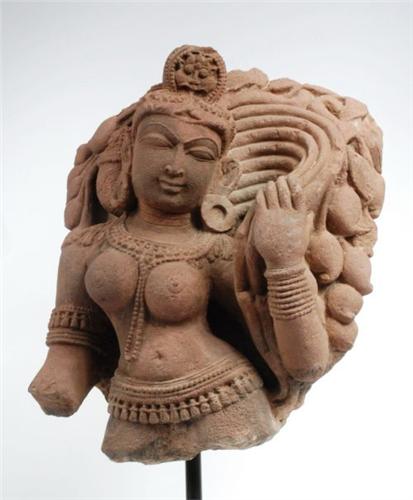


1.) Devi – the major female deity.


2.) Brahma – the Creator


3.) Shiva – the Destroyer
OK, go ahead and go to the Met and learn more:


4.) Vishnu – the Preserver

(I'll go into more detail on Vishna because there is more artwork to see)

Vishnu is known as the preserver of order.


Badami cave temples

Vishnu can be identified by his shield, disc and club. 


In the thousands of images of Vishnu we see numerous images of his three weapons taking on the form of animals, and images of his wife Shri Lakshima as well. 


Vishnu and Lakshmi riding on the Garuda

This all gets more interesting and complicated as Vishnu incarnates at least ten times. One of the most depicted is his incarnation into Krishna, the Gopi or cowherd. Krishna continues to be the subject of paintings and can be recognized by his blue skin and is typically portrayed as a "trickster."


Lord Krishna and Gopikas.


Krishna Stealing the Garments of the Unmarried Gopi Girls

Islamic Art
The Mughal dynasty began in 1526. Akbar (1556–1605) was the first great Mughal patron of the arts. Akbar was interested in spiritual and religious issues and included in his court, theologians who were Hindus, Jains, Christians, Jews, and Zoroastrians. 


The Walters Art Museum
The Virgin and Child
illuminated manuscripts; folios (leaves)
Mughal Dynasty
Date    1008-1034 AH/AD 1600-1625 (Mughal)
Material          ink and pigments on paper
Measurements            H: 12 x W: 7 15/16 in. (30.5 x 20.2 cm); Image H: 6 9/16 x W: 4 1/16 in. (16.7 x 10.3 cm)
The Walters Art Museum
 (Links to an external site.)http://thewalters.org

Description     This Mughal tinted drawing of the Virgin and Child, Walters manuscript leaf W.903, dates to the11th century AH/AD 17th. The Virgin Mary is shown in a diaphanous light pink garment seated beside two baskets. She looks toward the infant Jesus, who clasps her hand. The image documents Mughal interest in themes circulated by the Jesuits and European traders. The Virgin and Child were popular subject matter under the Mughal emperors, especially Akbar and Jahangir.

Mughal Paintings are miniatures or book illustrations that developed in the court of the Mughal Empire.


Ramayana; The Awakening of Kumbhakarna, the Giant Brother of Ravana
Illustrated manuscript, folio
Akbar (1556-1605)
Mughal period (1526-1858)
1595-1605
Material          Opaque watercolor and gold on paper
Measurements            10 7/8 x 7 3/8 in. (27.6 x 18.7 cm)
Credit Line       The Metropolitan Museum of Art, Cynthia Hazen Polsky and Leon B. Polsky Fund, 2002 (2002.504)


Sultan Muhammad Adil Shah


Ali Adil Shah

Since I was a slacker and didn’t post on Valentines day I have to include some love today…The Taj Mahal was built by Mughal emperor Shah Jahan in memory of his third wife, Mumtaz Mahal. It is one of the greatest examples of Muslim art in India.


Entrance building to the compound containing the Taj Mahal mausoleum
Taj Mahal, Agra, India
Photographer: Laurens Dawes
Yale University: Peabody Museum of Natural History

Rangoli isn’t actually an influence, but it is cool to see and watch, so here’s a bit of explanation and a video to bring this day to a close…


Rangoli is a form of sand painting decoration that uses finely ground white powder and colors, and is commonly used outside homes.

Grab some popcorn and watch contemporary Artist Purvi Shah and her students create a Rangoli Sand Painting:

Thanks very much reading!

Thursday, February 13, 2020

Joel Elgin. Influences: The Art of India


Joel Elgin. Influences: The Art of India

Welcome back. 

Still thinking about Cultural Appropriation? Good, here’s a challenge. To really understand how much appropriation is out there why don’t you put your computer/phone away (after reading this of course) and go on a scavenger hunt.
First step is you have to enter “sleuth’ mode. Wander your world with your phone/camera. When you spot an object that sports an “appropriated” image, snap a photo of it. Jot down what the object is and why you think it was appropriated and from what culture it was taken.
Warning: Be sleuthy but also respectful. Many people lack your level of SUAVENESS. They aren’t aware of the issue of “appropriation”. Your job here is to know how much appropriation is out there in the commercial world and thus discover your own visual definition of the term, not to preach.
If you photo your Aunt Amelia’s native American motif lampshades and call her out you could bring her to tears; you could be banned from all future family gatherings. One poor past student of mine accepted this challenge and shot a photo of a woman’s bikini that was decorated with a tribal design and poor Kadie ended up in the bottom of the pool when the woman objected to the candid photo. Another was escorted from Pier 1 and sadly, Allie is banned from ever entering the store again.
So be careful and respectful. I’m guessing you could start with your own possessions? You might have once spent a few bucks on something appropriated for profit from another culture before you became the suave person you are today.

The Art of India
To make our understanding of Indian art… more understandable, understand that the artwork can be classified into specific periods each reflecting particular religious, political and cultural developments. Understand?
Most important thing to know though is the influence of religion. India is the birthplace of Buddhism and Hinduism and the artwork was created to spread the teachings, the religious beliefs.

Ancient India Art
Buddhist Art
Hindu Art
Islamic

Ancient India Art
The earliest examples of art in India are petroglyphs.


Bhimbetka rock painting, Madhya Pradesh, India (c. 30,000 years old)

Harappan


Harappan's are the name given to any of the ancient people belonging to the Indus Valley civilization between 2600-1900 B.C.


The Harappan seals were fired clay most likely used for trade. The bull that commonly appears on the seals might have been associated with fertility cults.

Another possible ancient fertility cult object is the :


Dancing Girl
C. 2500 B.C.
Place of Origin: Mohenjodaro
Materials: Bronze
Dimensions: 10.5 x 5 x 2.5 cm.
Acc. No. 5721/195

The VEDIC period between period 1750 – 1500 BCE was a time when very little art was made but what was made, did influence future artwork. Key to the influence was the development of Dharma, a worldview or cosmic law that governed nature, human society and the supernatural world. Dharma and Samsara, the idea of endless rebirths will eventually lead to images that spread the word of the Buddha and the next stage of Indian Art, Buddhist Art.

Buddhist Art
Buddha, the Enlightened One, following six years of meditation, came to the realization that people could cease suffering by following eight steps of self discipline and virtuous behavior.

Sacred sights and architecture such as the Buddhist Temple at Karli, are considered the original Buddhist artworks.


Buddhist Temple at Karli
Carved into the interior of the temple were figurative images:


Mithuna: Buddhist relief

No images of Buddha were created until the First century CE.
The depiction of the Buddha had a number of consistent features.
1.) Frontal position
2.) Stationary pose
3.) When seated, assumes the lotus position (padmasana)

The hand positions/ gestures are symbolic mudras, reflecting a state of spiritual consciousness.
1.) dharmacharka – teaching mudra – thumb and index finger joined creating the Wheel of Law.
2.) abhaya – reassurance mudra – right hand, palm extended at shoulder height.
3.) dhyana – meditation mudra – both hands resting on the thighs, palms up, thumb tips touching.
4.) varada – gift bestowing mudra – left palm out with fingers pointing down.
 (Note – stay tuned for a number of images of Buddha in the coming posts that illustrate the body and hand positions)
Unlike many of the African sculptures, the Indian Buddha is not depicted wearing jewelry. He has renounced the material world. The Buddha does often have a spot on his forehead known as a urna. And a stylized shape on the top of his head, hair, known as ushnisha.


Seated Kapardin Buddha from Katra Mound

Bodhisattvas
Are Buddha like, or nearly Buddhas. They are enlightened beings who have remained on earth to help weaker people achieve enlightenment. The difference is that the Bodhisattvas are often depicted with more elaborate costumes and possessions, including a flask. It holds the elixir of life.


Bodhisattva statue at National Museum, New Delhi

The Gupta style,
Buddha imagery morphed through the Mathuran and Gandharan styles to the Gupta style during the Kushan Dynasty (50 -320). Rom 319 to 500, Golden Age of Indian art occurred during the reign of the Gupta Kings. The carving was refined, and the setting included with the Buddha became more detailed and elaborate.


Buddha sermon in Deer park

The Gupta Kings were Hindu and their beliefs reduced the power of the Buddhist religion.

Sorry, times up and that's enough India for one day - stay tuned for more and thanks for reading.

Tuesday, February 11, 2020

Joel Elgin. Influences. British Punitive Expedition of 1897 and Cultural Appropriation


British Punitive Expedition of 1897


.British soldiers sit surrounded by Benin works of art during the British Punitive Expedition of 1897 (documentary photograph by Sir Harry Holdsworth Rawson)


"...It was the looting of Benin that made African art visible to Europeans. When the seized artifacts were sold, entering the collections of museums, there was a sense of surprise and mystification. Although travellers had written descriptions of Benin City, this was the first time anyone outside Africa comprehended the scale of Benin's artistic achievement.
So the German anthropologist Leo Frobenius set out to study and collect African sculpture, while in Britain, serious publications - including, in 1899, the British Museum's catalogue of its Benin acquisitions - laid the foundations for the history of the art of Benin and that of Africa.

There were plenty of ambiguities. Frobenius could not believe that the 12th- to 15th-century brass heads of Ife, which are earlier than the art of Benin, were of African origin; he speculated that they were the work of ancient Greeks from the lost city of Atlantis..."
http://www.theguardian.com/culture/2003/sep/11/2 (Links to an external site.)

 Over the centuries, Benin had years of greatness and suffered times of turmoil, but a single event divides ancient from modern Benin. James Phillips, a British official in the Niger Coast Protectorate, led an unarmed expedition to Benin City in January 1897 to enforce trade agreements and a ban on reported human sacrifice. To prevent the British party from interfering with annual royal rituals, some chiefs ordered, against Oba Ovonramwen’s wishes, warriors to attack the expedition. Six British officials and almost 200 African porters were killed.

England responded immediately, mounting a “punitive expedition” to capture Benin City. The palace was burned and looted in February 1897, and the Oba was exiled to Old Calabar. To break the power of the monarchy and to end ritual practices, the British confiscated all of the royal art treasures, giving some to individual officers but taking most to auction in London to pay for the cost of the expedition…”

http://africa.si.edu/exhibitions/current-exhibitions/alonge/history-of-benin/ (Links to an external site.)

Getting the idea that this is a big deal?
It is!

In a nutshell, Oba Ovonramwen, the great ruler of Benin (Oba = ruler, king) taxed the British for using his resources. The British planned to march on Benin and stop the practice. Oba Ovonramwen told his people to wait for them to arrive but a group disobeyed him and attacked the on-marching British. The British retaliated by sending a large fully armed force against the city. After winning the battle they looted the city and took countless treasures. Europe had no idea such artwork was made in Africa before this, so more doors to destroying villages, and stealing were opened.  Money was to be made by stealing and selling this art!


Benin plaque: the Oba with Europeans
Benin, Nigeria, Edo peoples, 16th century AD

The Oba’s eventually regained their seats and have continued to rule Benin. The issue of the invasion/looting remains and is presented in this contemporary response to the British Punitive:

http://benin1897.com./benin.php (Links to an external site.)

In the exhibition catalogue,  Omo N' Oba's states: "The year 1897 means much to me and my people; it was the year the British invaded our land and forcefully removed thousands of our bronze and ivory works from my great grandfather, Oba Ovonramwen's Palace." Till date, families from the old kingdom still speak of their losses, in human and material terms, yet our world speaks tongue-in-cheek."

Suave lesson of the day. Who really owns the non - Western artwork that is behind glass cases in our museums?


https://news.artnet.com/art-world/benin-bronzes-restitution-1322807

As long as you are considering this why don’t continue on to the issue of “cultural appropriation”?
Time to test your sense of aesthetics. Look at the patterns and designs in the hair and jewelry in the NOK sculpture . Similar designs appear also in traditional Aso-Oke (pronounced ah-SHAW-okay), a strip-woven cloth. 


Nineteenth century Yoruba aso oke shawl, cotton and silk. The Metropolitan Museum of Art, New York

These textiles are thought to date back to the 10th century A.D.
Fabric doesn’t last as long as clay so the oldest forms no longer exist.

Aso-Oke, is still woven by the Yoruba people of Southwestern Nigeria.


Girl of the ethnic group ‘Fulani’ in Benin, West Africa. The traditional dress of the Fulani women consists of long colorful flowing robes. Image by Dietmar Temps


A Voodoo dancer – Benin – Traditional costumes – Image by luca.gargano
http://www.thelovelyplanet.net/tag/nigerians/ (Links to an external site.)

Here is an old video showing the weaving process:
How Aso Oke is Made (Yoruba tribe of Nigeria)
https://www.youtube.com/watch?v=rKLHD5dB3oc (Links to an external site.)

Aso Oke is labor intensive and not only beautifully rich with color and design but also filled with hundreds of years of tradition and meaning. 


The beauty of African art’s pattern and design was captured by the fashion world as early as 1967, when French designer Yves Saint Laurent launched his “Africa Collection”.

The fashion world praised him for taking the Western world into Africa. Harper’s Bazaar called Saint Laurent’s Africa Collection “a fantasy of primitive genius”. Saint Laurent went so far as to take credit for putting African fashion on the map.

SUAVE people like you know that there was nothing “primitive” about the pattern/design the gifted artists of Africa used. The artists did not need for Saint Laurent to “put them on the map”.

The term for this is
cultural appropriation. 

Cultural appropriation invalidates a culture and people, it commodifies (by placing monetary value), reinforces stereotypes, romanticizes and belittles people.
Of course it isn’t only the African culture that is a victim of cultural appropriation. 

The Lakshmi swimsuit designed by Lisa Burke depicting an image of the Hindu sacred goddess Lakshmi caused such an outcry that the designer pulled the suits from stores.
https://www.nydailynews.com/life-style/fashion/swimsuit-designer-lisa-blue-outrages-hindus-depicting-goddess-lakshmi-skimpy-bathing-suits-article-1.141181

Obviously, I am on a Cultural Appropriation rant so here is even more…
Urban Outfitters found they could make money by appropriating Navajo design:


Navajo Hipster Panty
Not just fashion, but everyday objects are too often examples of Cultural Appropriation:


"Navajo Flask"  

Enough ranting for this day. Stay tuned for the Influence of India.