Wednesday, September 16, 2020

Barbara Jones-Hogu and AfriCOBRA. Joel Elgin Athraigh Studio


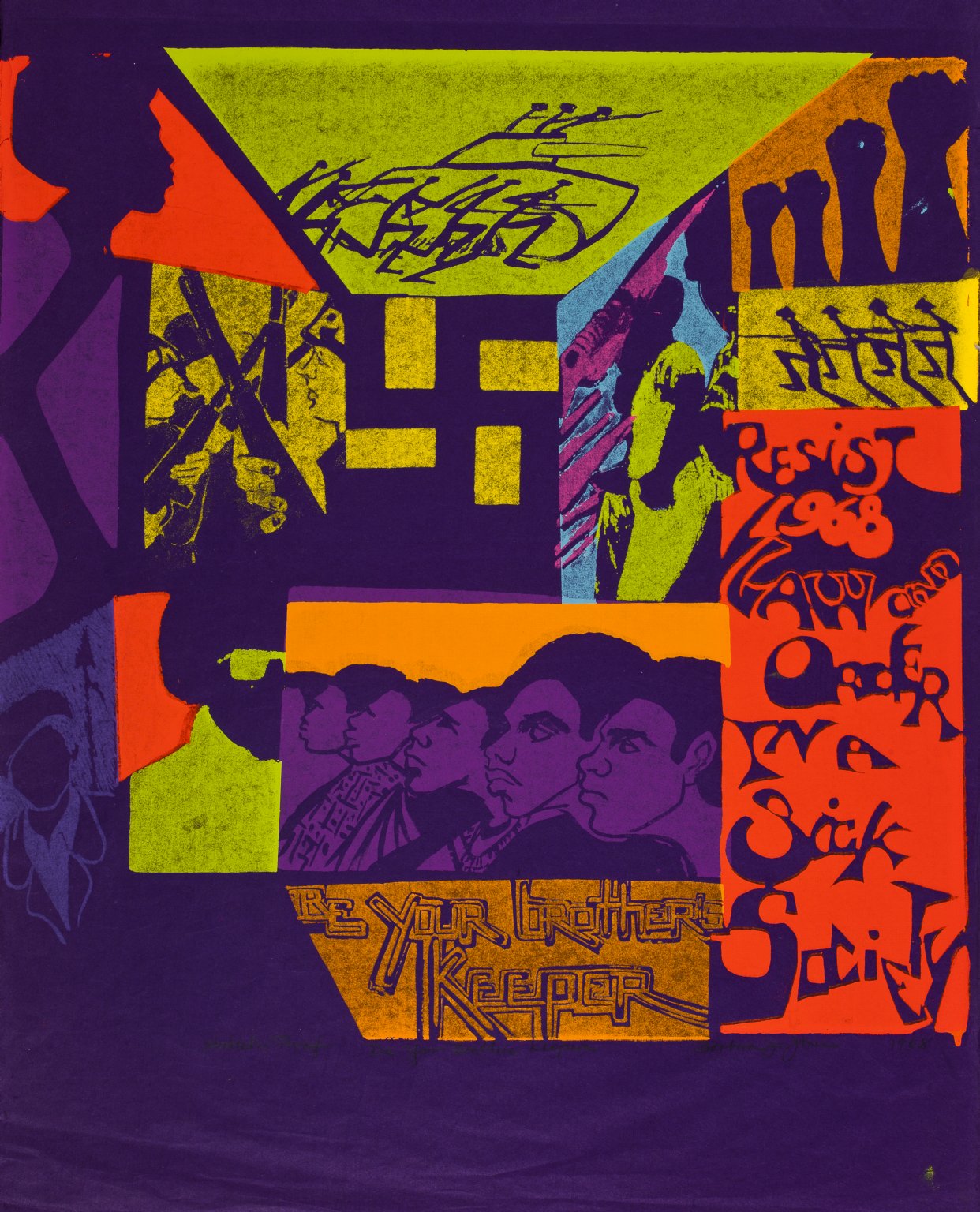
In 1968, printmaker Barbara Jones-Hogu was a founding member of the Chicago group, African Commune of Bad Relevant Artists (AfriCOBRA). The artists of AfriCOBRA made visual, the central ideas of the Black Power movement—self-determination, unity, and black pride.  They agreed to embrace a style that emphasized strong bold colors, flat shape, rhythm, and text to highlight the heroic and beautiful qualities of black lives in America.


https://americanart.si.edu/education/oh-freedom/barbara-jones-hogu


The prints created by Barbara Jones-Hogu, stand as brilliant works of art and at the same time reveal a glimpse into America’s history of embedded racism and the importance of protest.


Land Where My Father Died

Color screenprint on gold-colored Japanese-style laid paper. 1968,


“…I feel that racism and fascism played a great deal in my father being successful or not successful in his life, so some of these prints’ ideas and content deal with the fact that we and he were not really free to do whatever we and he really wanted to do and could do due to radical oppression and suppression…”

https://never-the-same.org/interviews/barbara-jones-hogu/


Nation Time

Color screenprint on gold-colored paper, 1970,


“…In Nation Time, a dominant figure leads a black ensemble to rise up against the American flag background. Closer looking reveals that the American flag’s stars are Ku Klux Klan members. In this way, the composition acknowledges how racism is deeply embedded in America, while also inspiring hope of overcoming that truth…”
https://blantonmuseum.org/2020/03/womens-history-month-2020-5womenartists-from-the-blanton-collection/


Be Your Brother's Keeper

Color screenprint, 1971

“…The guns and the lights on them and various actions against and between the military and the protesters caused me to think that we should be our brothers’ keeper…”

https://never-the-same.org/interviews/barbara-jones-hogu/


Unite (AfriCOBRA)

Color screenprint on ivory wove paper    1971


 YouTube Version:


For further information on Barbara Jones-Hogu and AfriCOBRA:


https://never-the-same.org/interviews/barbara-jones-hogu/


https://www.blackartinamerica.com/index.php/2017/11/16/barbara-jones-hogu-one-of-americas-greatest-artists-has-passed/


Joel Elgin Art Sites:


https://www.joelelginathraighprintstudio.com/

Instagram:

https://www.instagram.com/joel.elgin.athraighprintstudio/

Twitter:

https://twitter.com/athraigh


Monday, September 14, 2020

Ernest Crichlow: Cinque Gallery. Joel Elgin Athraigh Printmaking Studio


Athraigh Printmaking Studio’s series of small exhibitions continue today with its series of exhibits of African-American printmakers. The issues addressed by these artists are still current. I had not learned of many of these amazing printmakers in school and therefore, sadly, I did not expose my students to them. I hope that by bringing these artists to you now, you might have a better understanding of the long battle against racism, artists of color have fought and continue to fight today.


The Cinque Gallery was founded in 1969 by artists Romare Bearden (1911–1988), Ernest Crichlow (1914–2005), and Norman Lewis (1909–1979) to exhibit the work of both new and established African–American artists, and to provide community educational programs. The gallery was named after Joseph Cinqué, the leader of the Amistad slaveship mutiny of the 1830s. For more than three decades, Cinque sponsored more than 300 exhibitions in a number of New York City venues, as well as regional travelling exhibitions before closing in 2004.

https://www.aaa.si.edu/exhibitions/expanding-the-legacy-new-collections-on-african-american-art/cinque-gallery-records


1. Cinque Gallery brochure

Date: 1959-1981

Rendering of the Amistad, slave ship on which Joseph Cinqué led the historical uprising.

Cinque Gallery. Cinque Gallery brochure, 1959-1981. Cinque Gallery records, 1959-2010. Archives of American Art, Smithsonian Institution


Today’s exhibit will feature Ernest Crichlow (1914–2005) who describes his art:

“… I think I know now that this is valid and this is me and this is all that really counts. As I say, the styles will go by and I will hope that I'll have a place and that is all you can do…”

https://www.aaa.si.edu/collections/interviews/oral-history-interview-ernest-crichlow-11459


2. Untitled,

oil on masonite, circa 1942


3. Lovers

lithograph, 1938

…interior scene with Ku Klux Klansman struggling with African American woman in a bedroom.


4. Untitled

aquatint, 1988


5. Waiting

lithograph, 1965

…a lone child peering through a barbed wire fence.


For more on Ernest Crichlow, please go to:


https://beardenfoundation.org/cinque-artists-program/


https://www.aaa.si.edu/exhibitions/expanding-the-legacy-new-collections-on-african-american-art/cinque-gallery-records


https://pffcollection.com/artists/ernest-crichlow/


If you wish to view higher res images of this or any of the past articles please visit the Athraigh Print Studio:

https://www.joelelginathraighprintstudio.com/


Twitter:

https://twitter.com/athraigh

Instagram:

https://www.instagram.com/joel.elgin.athraighprintstudio/


YouTube Version:


Saturday, September 12, 2020

Elizabeth Catlett. Joel Elgin Athraigh Printmaking Studio


Please enjoy this short exhibition of prints and drawings by Elizabeth Catlett.


Elizabeth Catlett was born in 1915, in Washington, D.C. She was an advocate for social change in the U.S. and Mexico until she passed away in 2012 at age 96. Her prints are in the collections of the Metropolitan Museum, in New York, the Baltimore Museum of Art and the New Orleans Museum of Art.


1. Elizabeth Catlett

"Fiesta"

color screenprint


2. Elizabeth Catlett

I have given the world my songs,

 from "I am the Negro Woman" series, 1946-1947

Linocut


3. Elizabeth Catlett

Prissy. 1979

Lithograph on cream wove paper


4.Elizabeth Catlett

Untitled (Freedom). 1998

From the Freedom or Slavery: The Paul Robeson Portfolio

Color lithograph on cream wove paper


5.Elizabeth Catlett

Young Woman.

Drawing


6.Elizabeth Catlett

Singing Their Songs 1992

Lithograph on paper


7.Elizabeth Catlett

Bread (Derecho Alimentarse). 1952.

Linoleum cut on wove paper,


YouTube Version:


Joel Elgin Art Sites:

Website:

https://www.joelelginathraighprintstudio.com/

Instagram:

https://www.instagram.com/joel.elgin.athraighprintstudio/

Twitter:

https://twitter.com/athraigh


Thursday, September 10, 2020

Margaret Taylor Burroughs. Joel Elgin Athraigh Printmaking Studio


Margaret Taylor Burroughs was born on November 1, 1917 in Saint Rose, Louisiana.


She took earned a B.E. in Art Education and an M.A., in 1948 from the Art Institute of Chicago. Margaret was a printmaker who carved and printed linoleum block prints centered around images of African American Culture.


Margaret and her husband, Charles founded the Ebony Museum of Chicago, later called the of African American History in 1961.

In 1975 President Gerald Ford awarded her the  President’s Humanitarian Award.  She died in Chicago on November 21, 2010.


1. Black Venus, 1957

Linocut


2. Harriet Tubman 2001

lithograph


3. Folksinger 1957

Linocut


4. Birthday Party 1957

Linocut


5. Family 1963

Linocut


6. Black Madonna 1957

Linocut


YouTube Version:


Joel Elgin Art Sites:


Website:

https://www.joelelginathraighprintstudio.com/

Instagram:

https://www.instagram.com/joel.elgin.athraighprintstudio/

Twitter:

https://twitter.com/athraigh


Kay Brown. Joel Elgin Athraigh Printmaking Studio


“…Kay Brown (1932-2012) was an African American artist and one of the founders of the Where We At Black women artists’ collective in New York City. She was also a member of the Weusi Artist Collective, based in Harlem during the 1960s and 1970s….”

http://www.shadesofnoir.org.uk/creatives/portfolio/kay-brown/


Weusi Artist Collective:

A Swahili word meaning blackness, “Weusi” is also the name of a distinguished collective of artists established in Harlem during the 1960’s against the Black Arts Movement. This video is a sampling from interviews with 17 Weusi artists still working in New York City.

http://whirlwindcreative.com/weusi/


Where We At Black Women Artists' Collective:

“ … In early 1971, Kay Brown, Dindga McCannon, and Faith Ringgold gathered a group of black women at McCannon’s Brooklyn home to discuss their common frustrations in trying to build their careers as artists… Out of this initial gathering came one of the first exhibitions of professional black women artists: “Where We At”—Black Women Artists, 1971. Adopting the show’s title as its name, the collective began meeting at members’ homes and studios, building support systems for making their work while assisting each other with childcare and other domestic labor. Where We At recognized the power of collectivity—empowering black women by creating a network to help them attain their professional goals as artists…”

https://www.albrightknox.org/blog/exhibition-spotlight-dindga-mccannon-and-%E2%80%9Cwhere-we-%E2%80%9D-black-women-artists-we-wanted-revolution


The Devil and His Game

collage of various papers and mixed media on canvas, 1970

 
The Kick of Life

color etching and aquatint. 1974


Black Mother and Male Child

etching and aquatint on cream wove paper. 1974–1975


Meditation 

etching, aquatint 


Willowbrook

etching, aquatint 


You Tube Version: 


Tuesday, September 8, 2020

Emma Amos. Joel Elgin. Athraigh Printmaking Studio


Printmaking/Art History. Black Printmakers/Artists: Emma Amos.


In August of 1963, The March on Washington was held to advocate for the civil rights of African Americans. Martin Luther King Jr delivered his "I Have a Dream" speech, calling for an end to racism.

The art collective, The Spiral Group formed as a result of the march.

“…Spiral was a New York–based collective of African-American artists that came together in the 1960s to discuss their relationship to the civil rights movement and the shifting landscape of American art, culture and politics…”

https://studiomuseum.org/exhibition/spiral-perspectives-african-american-art-collective

An artist in the group who I particularly admire is Emma Amos.

Emma Amos (1937 – 2020) was invited in 1963, by her professor,  “…Hale Woodruff to become a member of Spiral, a group of black artists that included Romare Bearden, Norman Lewis, and Charles Alston. She was the group’s youngest and only female member…”

http://emmaamos.com/about/bio/

Prints and paintings by Emma Amos are in the collections of the Museum of Modern Art, the Studio Museum of Harlem, the Whitney Museum of American Art, and the Brooklyn Museum. Emma Amos died on May 21 at her home in Bedford, N.H. She was 83. In 2021, a retrospective of the artist’s work will open in her home state, at the Georgia Museum of Art in Athens.

Stars and Stripes,

monotype with George Shivery photo transfer, 1995


About Whiteness (Red)

oil and laser transfer on paper. 1995

Measuring, Measuring

Acrylic on linen canvas, Kente fragment, batiked hand swatches, African strip woven borders, and laser-transfer photographs, 1995

Mississippi Wagon, 1937,

print, 1992

My Mothers, My Sisters,

lithograph, handmade paper collage, African fabric border, 1992


Contemporary African American artists continue the work of Spiral:

Black Art In America

SPIRAL NOW 55 Years Later: New Artists, Familiar Struggle

https://www.youtube.com/watch?v=6Pasz9lP888


SPIRAL NOW 55 Years Later: New Artists, Familiar Struggle

https://www.marchonwashingtonfilmfestival.org/2018-festival-guide/2018/7/12/festival-art-exhibit-spiral-now-55-years-in-the-making-new-artists-familiar-struggle


More on Spiral and Emma Amos:

https://studiomuseum.org/exhibition/spiral-perspectives-african-american-art-collective


https://www.artnews.com/art-news/news/emma-amos-dead-1202688259/


Please check out the video version:


Wednesday, August 26, 2020

The Influence of Black Artists: Dr. Samella Lewis


The Influence of Black Artists:

Dr. Samella Lewis.


Joel Elgin, Athraigh Studio.

SAMELLA LEWIS, born in New Orleans in 1924 is rightfully considered one of the most influential artists/art historians in the United States.


“… As a young artist, she was drawn to subjects as diverse as police brutality against African Americans, comic books, and characters from her older sister's romance novels…”

https://hammer.ucla.edu/now-dig-this/artists/samella-lewis


She “…became the first African American to receive doctorates in Fine Art and Art History.  Dr. Lewis attended Dillard University, Hampton Institute, and Ohio State University. She taught as a full-time professor at Morgan State University, Florida A&M, State University New York Plattsburgh, California State Dominguez, California State Long Beach, and Scripps College…”

https://www.blackartinamerica.com/index.php/2019/03/11/dr-samella-lewis-the-godmother-of-african-american-art/


Dr. Lewis  “…was an active member of the National Association for the Advancement of Colored People, making her a target of government officials who accused her of being a Communist and members of the Ku Klux Klan who shot out windows of her home. Undaunted, she founded a chapter of the NAACP in Plattsburgh.

https://www.louissternfinearts.com/samella-lewis-bio


‘Lewis has changed the landscape of Art History and has become an influential and highly respected voice that has also mentored and bolstered the careers of many African American artists. She is the recipient of a myriad of awards and distinctions and has exhibited in many important galleries and museums.”

http://www.stellajonesgallery.com/samella-lewis


I See You

Linocut.  2005


Migrants,

Linocut. 1968

 “I fight against segregation, discrimination, racism, brutality and depravity because these things deny people their rights as human beings.” -- Samella Lewis. (Credit: Daily Bulletin)


House of Shango

Lithograph. 1992


“The title of this piece is an unmistakable harkening to African roots. Shango is a religious practice with origins in Yoruba (Nigerian) belief, deifying a god of thunder by the same name…”

https://rcwg.scrippscollege.edu/blog/2016/10/02/highlights-of-the-collection-samella-lewis-house-of-shango/


First Phase

hand-colored lithograph. 2005


 Please visit the Athraigh Print Studio webpage:


Athraigh Print Studio Website:

https://www.joelelginathraighprintstudio.com/


Instagram:

joel.elgin.athraighprintstudio


Twitter:

https://twitter.com/athraigh


More on Samella Lewis:


https://www.blackartinamerica.com/index.php/2019/03/11/dr-samella-lewis-the-godmother-of-african-american-art/


https://www.louissternfinearts.com/samella-lewis-bio


http://rcwg.scrippscollege.edu/blog/2008/07/09/samella-lewis/


http://www.stellajonesgallery.com/samella-lewis


https://hearnefineart.com/artists/53-samella-lewis/biography/